.png)


 英文
英文

In the freight forwarding world, there's an old saying about moving construction machinery on special containers (flat racks and open tops): whether the cargo sails is the carrier's call; whether things go wrong is the declaration's call. Get the over-dimension declaration right, and it's routine. Get it wrong, and it's an incident. This article breaks the process down step by step — use it as a checklist before your next shipment.
1. Know Your Equipment Type Before You Talk About Over-Gauge
Three mainstream options exist for shipping construction machinery on special containers:
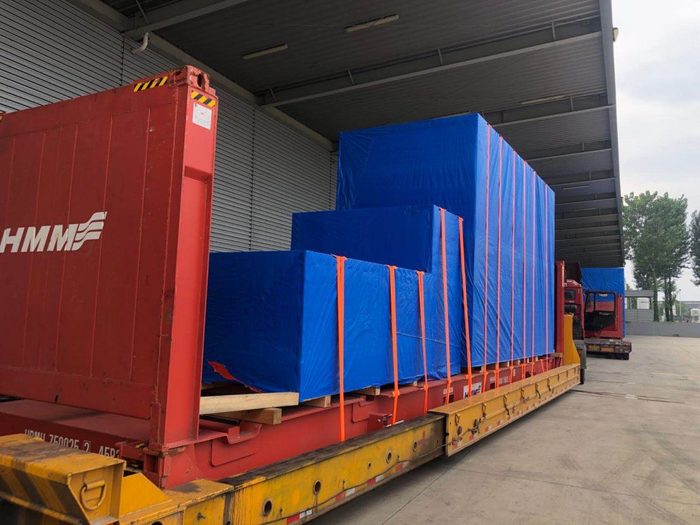
40FR / 45FR flat racks: no side walls, no roof, corner posts securing the cargo base — the first choice for over-wide, over-height, over-length cargo. Excavators, loaders, and rollers mostly go this way;
20FR flat racks: for smaller equipment or heavy units;
OT (Open Top) containers: mainly for over-height cargo, open at the top and covered with a tarpaulin — think twice for moisture-sensitive machinery.
"Over-gauge" (OOG, Out of Gauge) is measured against the container's external dimensions. Take a 40' flat rack: the container is 2.44 m wide, so any cargo wider than the box frame counts as over-wide; the same logic applies to height and length. On payload, the rated capacity is stated on the CSC plate from the container owner — 20' racks sit in the 20-tonne class, 40' racks commonly above the 30-tonne class. Check the machine's operating weight against the plate before booking; never load to the razor's edge.
2. Measuring: Every Failure Starts Here
The first rule of OOG declaration: the dimensions submitted to the carrier must be the final, loaded dimensions — not the nameplate figures. For construction machinery, the most commonly missed measurement points are:
Protrusions. Cab, guardrails, exhaust stacks, track shoe edges, outrigger pads — every protruding element counts toward the declared dimensions;
Packing and cradles. Wooden dunnage, steel skids, corner protectors all count. If the machine was partially disassembled (say, the cab removed and crated separately), measure the actual post-disassembly loading configuration;
Re-measure after loading. Theoretical and actual dimensions never fully match. Once the machine is mounted and secured, re-measure length, width, and height on site with a laser rangefinder or tape, and photograph everything;
Center of gravity. OOG stowage plans require the COG position. Off-center loading directly affects the vessel's lashing arrangement and lifting plan.
A textbook lesson: one shipment declared 15 cm over-wide. On arrival at the terminal, actual measurement showed 40 cm over — crossing the carrier's surcharge tier boundary was the least of it. The planned deck slot couldn't take the cargo, the container got rolled, and the whole shipment waited nearly three weeks for the next sailing. A few centimeters of error, billed by the day.
3. The Declaration Process: Lead Time Is Schedule Time
OOG booking runs on a completely different rhythm from standard containers:
Inquiry and booking: provide the packing list, equipment photos, three-dimensional measurements, weight, and COG — a simple drawing helps. The carrier reviews stowage feasibility based on this data;
Carrier approval: OOG slots are not the forwarder's call. The carrier approves based on each voyage's stowage plan. In peak season, start booking at least two weeks ahead — special containers run scarce and approval timelines stretch;
OOG surcharge confirmation: over-width, over-height, and over-length are charged separately, tiered by the degree of excess. Rates differ by carrier and port. Ask your forwarder to itemize the OOG surcharge in the quote — don't let it hide inside the ocean freight only to become a dispute later;
VGM declaration: verified gross weight is required under the SOLAS convention. Flat rack cargo is essentially always weighed on a scale — estimated figures won't pass.
4. Four Common Failure Points
Understating dimensions. Shaving the declared size to save on OOG surcharges is the dumbest saving in the industry. The terminal crane measures on the spot — at best you pay the difference and lose your slot; at worst you miss the vessel and land on the carrier's blacklist;
Manifest data mismatch. Weight and dimensions on the customs declaration, manifest, and VGM must be identical. Any discrepancy and you get stuck between customs and the carrier;
Missing lashing plan. OOG lashing follows the IMO CSS Code (Code of Safe Practice for Cargo Stowage and Securing). Construction machinery on flat racks needs at minimum four-directional lashing with wire rope and turnbuckles, plus anti-tip bracing for high-COG units;
Destination conditions unconfirmed. The cargo is 60 cm over-wide — can the destination port handle it? Can the trucking permit be obtained? Confirming before departure beats staring at each other after arrival, a hundred times over.
5. Never Skip On-site Loading Supervision
On loading day, the right people must be present: the shipper's representative or appointed supervisor, the lashing team, the driver. The post-loading checklist: re-measure dimensions against the declaration, check lashing point tension, photograph all four sides plus the top and nameplate, and sign the loading confirmation. This record serves as handover evidence for the carrier — and as first-hand evidence in any cargo claim.
6. The Bottom Line
An OOG declaration is, in essence, translating the cargo's true form to the carrier and the port — early, complete, and accurate. Measure right, book early, keep the three documents consistent, document the lashing — do these four things, and over-gauge cargo moves as steadily as standard boxes. For shippers running multiple batches with mixed dimensions, having a forwarder with an in-house lashing team and daily 40FR/45FR experience on site beats remote-commanding the process yourself, every time.