English
Typhoon Dolphin, the 13th named storm of the 2026 Pacific typhoon season, is advancing west-northwest with unstoppable momentum. As of 8:00 AM on August 6, its center was located approximately 1,300 kilometers east of Wenzhou, Zhejiang Province, over the northwestern Pacific, with maximum sustained winds of force 14 (42 m/s) and a minimum central pressure of 955 hPa. The Central Meteorological Observatory has maintained a typhoon blue warning, while the National Marine Environmental Forecasting Center has simultaneously issued an orange wave alert. Dolphin is forecast to enter the East China Sea via the Ryukyu Islands on August 7, with the highest probability of making landfall between Cangnan (Wenzhou) and Jinshan (Shanghai) on the afternoon of August 9 or August 10, at typhoon or severe typhoon intensity (force 12 to 14). For the eastern China port cluster still reeling from the consecutive strikes of Typhoons Bavi and Hongxia, this weekend may bring yet another round of operational shutdowns.
I. A "Marathon" Ocean Giant: Why the Track Kept Shifting Westward
Dolphin is no ordinary typhoon. It formed on July 27 near 177°E, close to the Pacific International Date Line, making it the most easterly-originating typhoon to strike China since records began in 1951, breaking the previous record held by Typhoon Mangkhut (1822). Since being designated, it has traversed over 4,700 kilometers, earning it the rare distinction of a "marathon" typhoon.
Its unique attributes directly compounded forecasting difficulty. First, its extremely remote genesis and exceptionally long lifespan meant that atmospheric circulation patterns underwent massive changes during its extended transit, multiplying track uncertainty. Second, its circulation diameter exceeds 1,000 kilometers, with cloud cover equivalent to seven Zhejiang provinces; such a large-scale circulation is simultaneously tugged by multiple weather systems, making its path more prone to wobbling. Third, the persistent El Niño of 2026 has significantly warmed the central-eastern equatorial Pacific, expanding the warm water pool eastward. Sea surface temperatures along Dolphin's path consistently exceed 30°C, continuously supplying heat and moisture, while low vertical wind shear and efficient upper-level outflow channels collectively fostered this "ultra-long-endurance" giant.
Early forecasts had suggested Dolphin would most likely strike Japan, but within days, models shifted dramatically westward. The primary driver was an anomalously strong subtropical high that dominated eastern China through July and August, acting as a massive wall of air to the north. Steady easterly flow on its southern flank pushed Dolphin westward along approximately 25°N. The critical turning point arrives on August 7: as Dolphin passes through the Ryukyu Islands into the East China Sea, the subtropical high is expected to weaken and fracture simultaneously, destabilizing the steering flow. The typhoon's forward speed will slow, possibly stalling, after which the track diverges into two scenarios, either making landfall in Zhejiang and then recurving northward, or turning north over the sea and transiting through the Zhoushan archipelago. Regardless of which path materializes, heavy wind and rain along the Zhejiang coast and across the entire East China Sea are now unavoidable.
II. Eastern China Ports Already Operating "Wounded"
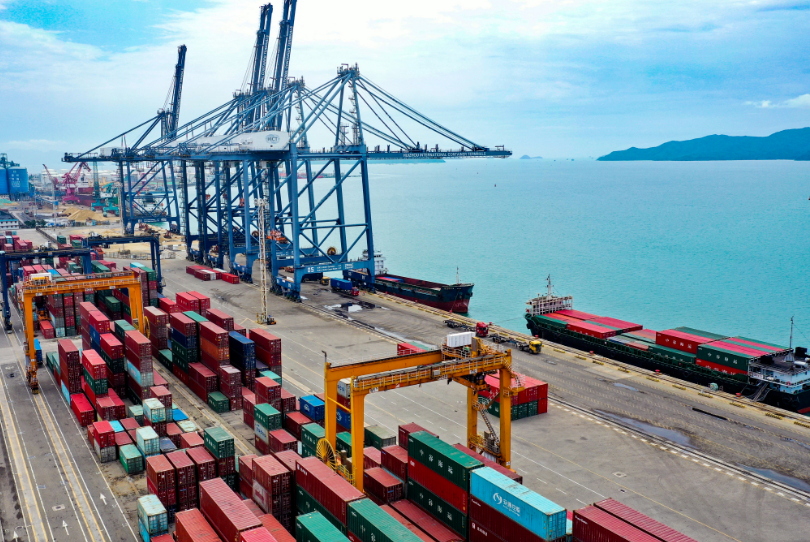
As Dolphin approaches, eastern China ports have yet to recover from the trauma of two prior typhoons. Typhoon Bavi, with a circulation diameter exceeding 1,500 kilometers, forced Shanghai and Ningbo, the two largest ports, to fully suspend container loading and discharge operations starting July 10. When Typhoon Hongxia made landfall on July 26, congestion worsened rather than eased. According to a July 28 alert from Kuehne+Nagel, six major container ports — Shanghai, Ningbo, Qingdao, Shenzhen Yantian, Shekou, and Guangzhou Nansha — were all flagged as "severely disrupted."
Hapag-Lloyd's Week 31 port report revealed: Shanghai Yangshan Phase III waiting time soared to 12 days (144 hours), Waigaoqiao 8 days; Ningbo still saw queues exceeding 3 days after reopening, with average berthing waits of 48 hours; Qingdao faced 3 to 4 days, averaging 72 hours. Yantian implemented ETB-7 gate restrictions from July 27 (accepting only loaded containers within 7 days of estimated berthing), with daily appointment quotas locked at 9,000 TEU. Shekou added a 120% per-voyage container acceptance cap on top of ETB-7 from August 3. Ningbo-Zhoushan's Meishan terminal area yard utilization once approached 90%. Approximately 2 million TEU of capacity has been affected. Maersk issued three consecutive advisories, canceling Shanghai calls on its Dragon and Northern Star services and diverting to Xiamen or Hong Kong.
This means that before Dolphin even arrives, the port system's margin for error is near zero. Any new round of navigational closures will compound pressure on an already backlogged fleet and cargo volume.
III. Emergency Responses Escalate Across Multiple Regions
As Dolphin bears down, maritime authorities along the coast are rapidly escalating emergency responses.
Zhejiang Maritime Safety Administration activated a Level III typhoon emergency response at 8:00 PM on August 5. By that time, all 193 maritime construction projects across Zhejiang had ceased operations, 474 construction vessels were transiting to safe anchorage, and local governments had evacuated over 10,000 people from remote islands including Huaniao, Dachen, and Nanji. Ningbo Maritime Safety Administration simultaneously activated Level III, with 46 coastal projects halted and 22 passenger routes suspending service based on wind conditions.
Zhoushan Maritime Safety Administration took early action, activating Level IV at 6:00 PM on August 3. From the afternoon of August 6, multiple water passenger routes — including Shenjiawan to Huaniao, Gouqi, Huanglong, and Shengshan — suspended service. All vessels from the "Tong-Su-Jia-Yong" high-speed rail marine construction project had transited to Yeyashan anchorage for shelter. Taizhou activated Level IV, with 29 construction projects halted, 65 construction vessels required to reach safe waters by 6:00 PM August 6, 8 of 18 passenger routes suspended, and over 800 commercial and fishing vessels densely anchored at Jiaoshan port area.
Shanghai Maritime Safety Administration activated Level IV on the morning of August 6, urging vessels to implement typhoon safety measures. Fujian Province completed the evacuation of all fishing vessels from designated fishing grounds (including the waters of Diaoyu Dao) and activated Level IV. Guangdong Maritime Safety Administration imposed traffic control on vessels transiting northward through the southern Taiwan Strait from 6:00 PM on August 6.
IV. Supply Chain Cascade Risk: 66 Million Tonnes of Commodities at Stake
Dolphin's threat extends beyond port closures themselves to the cascading impact on global supply chains. According to Signal Group data, Weeks 32 to 33 (August 5 to 18) are expected to see over 66 million tonnes of bulk commodities discharged at Chinese ports, including 20.4 million tonnes of iron ore in Week 32 and 23.9 million tonnes in Week 33, plus thermal coal, coking coal, bauxite, soybeans, and nickel ore. Any interruption to port operations would rapidly amplify demurrage and anchorage congestion.
Container shipping is equally exposed. Alphaliner data shows that Typhoon Bavi already caused a noticeable increase in container vessel congestion at Chinese ports, with recovery still incomplete. Maersk has announced a typhoon season precaution plan, alternating omissions between Shanghai and Ningbo on its Dragon service. All vessel segments — dry bulk, container, tanker, and gas carriers — face exposure. Once ports close for safety reasons, the rush for limited berths upon reopening will intensify congestion further.
The hidden costs spawned by port congestion are equally significant. Container drop-off fees, normally 400 to 500 RMB per unit, have been inflated to 800 to 1,000 RMB, with extreme cases reaching 4,000 to 6,000 RMB. Truck detention fees and secondary return charges have risen in tandem. Against the backdrop of peak export season and GRI rate increases, small and medium-sized shippers bear the brunt.
V. The Weekend Is the Critical Window
August 8 to 10 marks the critical window for Dolphin's impact on the eastern China coast. The Zhejiang Provincial Meteorological Observatory forecasts scattered showers from August 8 under the influence of outer circulation, escalating to torrential rain from August 9 to 10, with gusts of force 8 to 9 on the plains and force 10 to 11 at high altitudes. East China Sea winds will intensify to force 10 to 13 on August 7 to 8, with certain areas reaching force 13 to 16 from the night of August 8 through August 10, and winds exceeding force 16 near the typhoon center.
For foreign trade enterprises and freight forwarders, the most urgent priority is not predicting which path the typhoon will take, but building resilience to absorb volatility: closely monitor maritime authorities' typhoon response levels and port operational updates, confirm routing adjustments with carriers in advance, rationally assess container storage costs, and avoid concentrating operations near cargo cut-off deadlines. Based on historical typhoon impact patterns, port recovery depends not only on when the weather clears, but also on clearing the backlog of vessels and cargo accumulated during the closure — even if the typhoon's direct impact is brief, post-recovery transport pressures may persist for weeks.
In the summer of 2026, where a triple typhoon onslaught overlaps with peak shipping season, every shutdown of eastern China ports tests the resilience limits of the supply chain. And this weekend will be yet another major test.
Disclaimer: Data in this article is sourced from public channels for industry analysis purposes only and does not constitute any decision-making advice. Actual freight rates and port conditions are subject to official announcements.