.png)


 英文
英文
The container spreader is the core operating component used by port, terminal, railway yard, and shipboard cranes for lifting containers. It connects to the container corner castings via twist-lock me···

Container Spreader
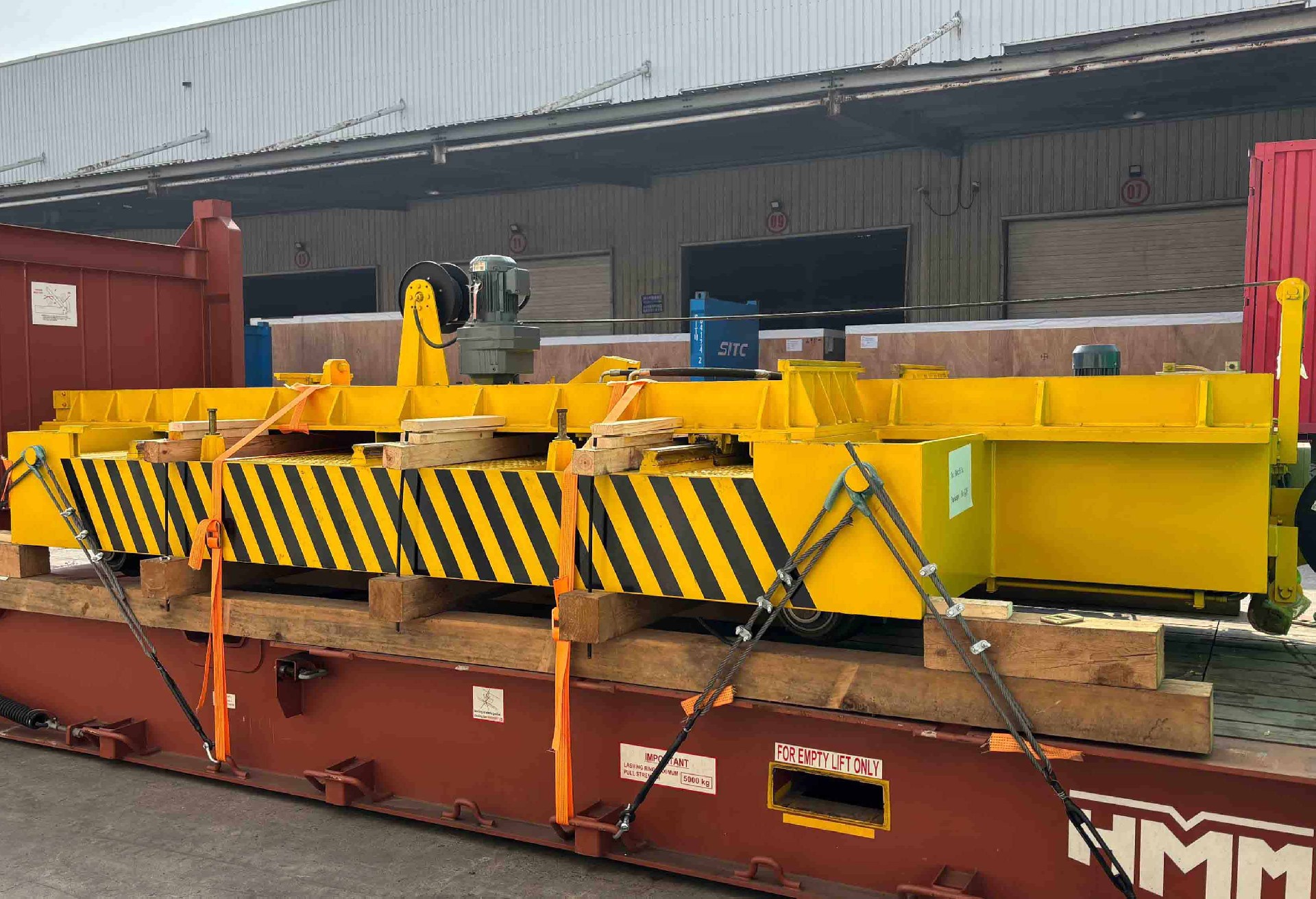

Container Spreader Transport
服务详情
The container spreader is the core operating component used by port, terminal, railway yard, and shipboard cranes for lifting containers. It connects to the container corner castings via twist-lock mechanisms, enabling rapid loading and unloading. We provide professional transport services from manufacturing plants, repair workshops to ports, container yards, shipyards, or operational sites. Spreaders can be shipped as a whole or in dismantled parts.
Common Types
Fixed Spreader (dedicated to 20ft or 40ft containers)
Telescopic Spreader (adjustable between 20ft and 40ft)
Twin-lift Spreader (capable of lifting two 20ft containers simultaneously)
Shipboard Container Spreader (for ship-mounted cranes)
Spreader Headblock (connecting crane wire ropes to the spreader)
Twist-locks and hydraulic accessories (shipped independently)
Key Transport Challenges
Elongated and Irregular Shape: Spreaders are typically long rectangular frames, 6 to 12 meters in length, about 2.5 meters wide. Twist-lock mechanisms, hydraulic cylinders, cable ducts, and control boxes protrude around the perimeter.
Heavy Single-Unit Weight: Standard spreaders weigh 3 to 8 tons; twin-lift or heavy-duty spreaders can reach 10 to 15 tons.
Precision Components Prone to Damage: Twist-lock pins, proximity switches, hydraulic hoses and fittings, sensors, and other precision parts protrude beyond the spreader frame, making them vulnerable to bending, breakage, or leakage during transport impact.
Uneven Weight Distribution: Hydraulic power units and cable reels are often located on one side, requiring careful balance point identification during lifting and loading to prevent tilting.
High Surface and Mounting Surface Requirements: The bottom face of the spreader (the contact surface with the container) must remain flat and free of dents; otherwise, twist-lock alignment may be affected. Paint damage may result in port rejection.
Oversized Dimensions Common: 12-meter spreaders exceed the length of standard flatbeds, requiring oversize transport permits.
Our Transport Solutions
Packaging & Protection
Whole spreaders are transported bare on low-bed flatbeds. Place wooden sleepers or rubber pads under the spreader, avoiding twist-locks and sensor locations.
Protect protruding components such as twist-lock mechanisms, hydraulic valve blocks, and proximity switches with bubble wrap or rubber protective sleeves, covered with plastic caps.
Fit dust caps or seal tape on hydraulic hose fittings, cover with plastic bags and tie securely to prevent oil leakage and foreign matter ingress.
Coil control cables and plugs separately, label them, place in waterproof bags, and secure in the spreader's internal empty space.
For dismantled components such as headblocks and twist-lock assemblies, use wooden crates or steel-frame boxes with internal cushioning material.
Lifting & Securing
Lift using the spreader's built-in lifting lugs. Confirm the rated load of the lugs before use.
If lugs are unsuitable or inconveniently located, use nylon slings for basket lifting, passing through structural holes in the spreader main beam, avoiding hydraulic cylinders and hoses.
Place wooden dunnage under the spreader on the flatbed so that twist-locks are suspended and not subjected to pressure. Secure using chains or straps from four directions: both ends and the center.
For spreaders exceeding 12 meters in length, install warning lights and reflective markings on the vehicle tail.
Transport Modes
Open-top container: suitable for small fixed spreaders of about 6 meters. Load the spreader and secure both sides with air bags or wooden dunnage.
Flat rack container: suitable for 8- to 12-meter spreaders. Place the spreader directly on the flat rack floor and secure around the perimeter with chains.
Breakbulk on deck: suitable for large quantities or over-length spreaders. Bare stowage with welded bases and lashing.
Road Transport: Use low-bed flatbeds or extended flatbeds. For over-length spreaders, apply for oversize transport permits in advance and plan the route.
Sea Freight:
Multimodal Transport: Road + sea combined for door-to-door service from factory to destination port.
Value-added Services
Pre-shipment photos of key parts such as twist-locks, hydraulic piping, and control boxes.
Assistance with export customs declaration (HS code typically falls under crane accessories or container handling equipment).
Coordination of crane offloading at destination port and placement at customer's designated location, such as terminal equipment warehouse or yard.
Anti-rust treatment for flanges and exposed metal surfaces.
Our Advantages
Long-term experience in container spreader transport; familiar with protection requirements for precision components such as twist-locks, proximity switches, and hose fittings. Lashing operations avoid stress concentration points.
Inspect hydraulic hose fitting seals and apply leak prevention measures before shipment.
Place soft wood or rubber under the spreader bottom face (container contact surface) to prevent paint scratches and local dents, ensuring arrival condition meets port acceptance standards.
For spreaders of 12 meters or longer, apply for oversize transport permits in advance and declare the route to ensure legal and compliant passage.
Spreader main body can be shipped together with twist-lock spare parts, cable reels, hydraulic power units, and other companion components in a single batch, reducing client coordination efforts.
If the destination port lacks offloading equipment, arrange a mobile crane or truck crane in advance to assist unloading.